

Special Economic Zones (SEZs) in India: Meaning, Benefits, Challenges, Real Estate Impact & Future
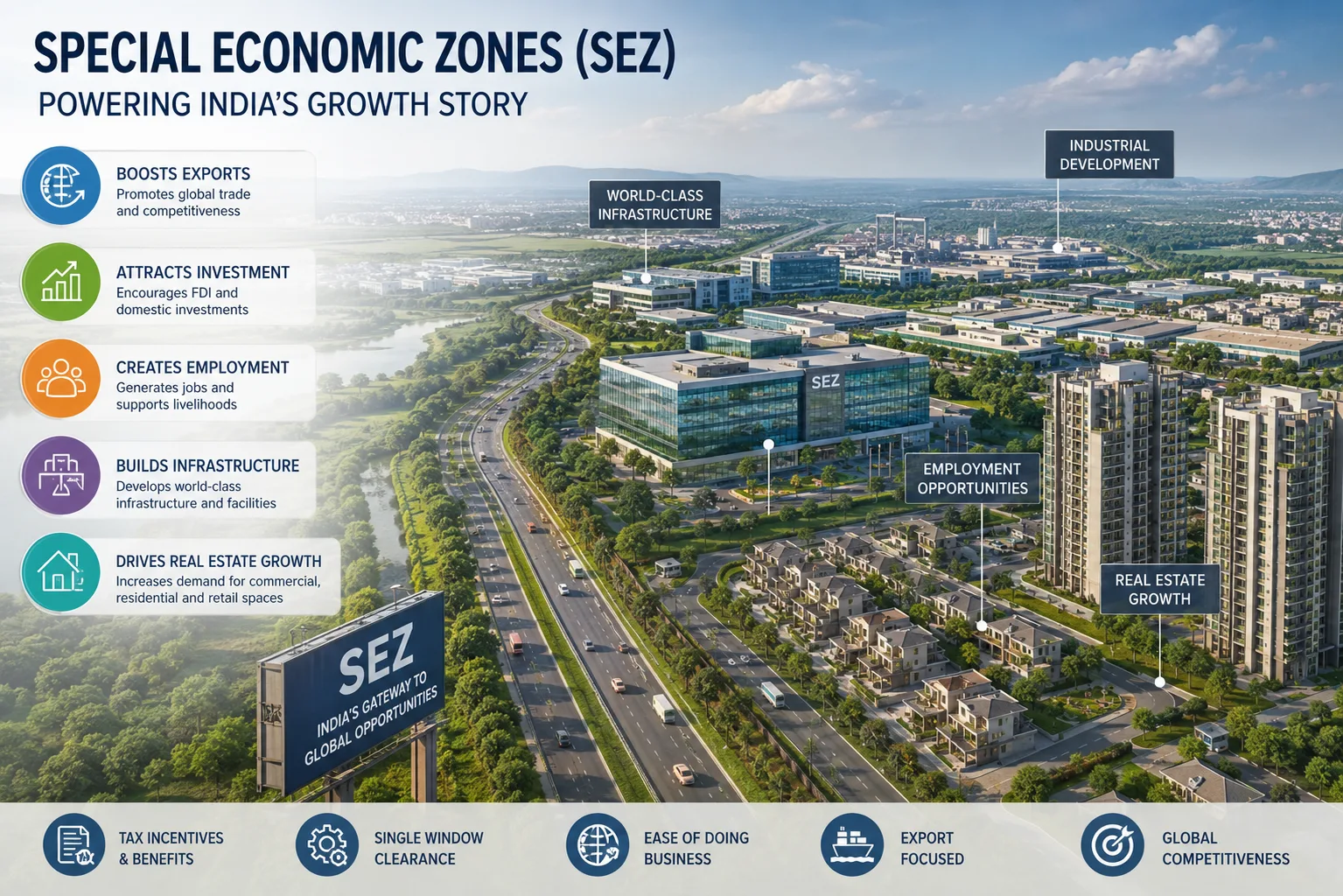
India’s economic landscape is changing rapidly. New industrial corridors, technology hubs, logistics networks and employment centres are reshaping cities and creating new real estate markets.
One of the important components of this transformation is the Special Economic Zone (SEZ).
SEZs were introduced to create business-friendly environments that support exports, investment, employment and industrial development. But their influence extends beyond business operations. A successful SEZ can create an entire economic ecosystem around itself, increasing demand for offices, housing, retail, hospitality, logistics and supporting infrastructure.
For real estate investors, developers and homebuyers, understanding the relationship between SEZs and property markets can therefore provide valuable insight into emerging growth corridors.
As of June 30, 2025, India had 419 formal SEZ approvals, 370 notified SEZs and 276 operational SEZs. The Ministry of Commerce and Industry also reported 6,279 approved units in SEZs as of March 2024.
This guide explains what SEZs are, how they work, their advantages and challenges, and—most importantly—how SEZ development can influence India’s real estate market.
What Is a Special Economic Zone (SEZ)?
A Special Economic Zone (SEZ) is a designated geographical area in India that operates under a specialised economic and regulatory framework intended to facilitate trade, investment and business activity.
India’s modern SEZ framework is governed primarily by the Special Economic Zones Act, 2005, and the accompanying SEZ Rules.
An SEZ is not a separate country or territory outside India. Instead, certain trade, customs and taxation provisions provide businesses operating within eligible SEZs with special treatment under Indian law.
The basic objective is to create an environment where businesses can operate efficiently, access specialised infrastructure and participate more effectively in international trade.
SEZs may support activities such as:
- Information technology and IT-enabled services
- Electronics
- Pharmaceuticals
- Biotechnology
- Engineering
- Textiles
- Manufacturing
- Gems and jewellery
- Logistics and warehousing
- Other eligible services and export-oriented activities
How Do SEZs Work in India?
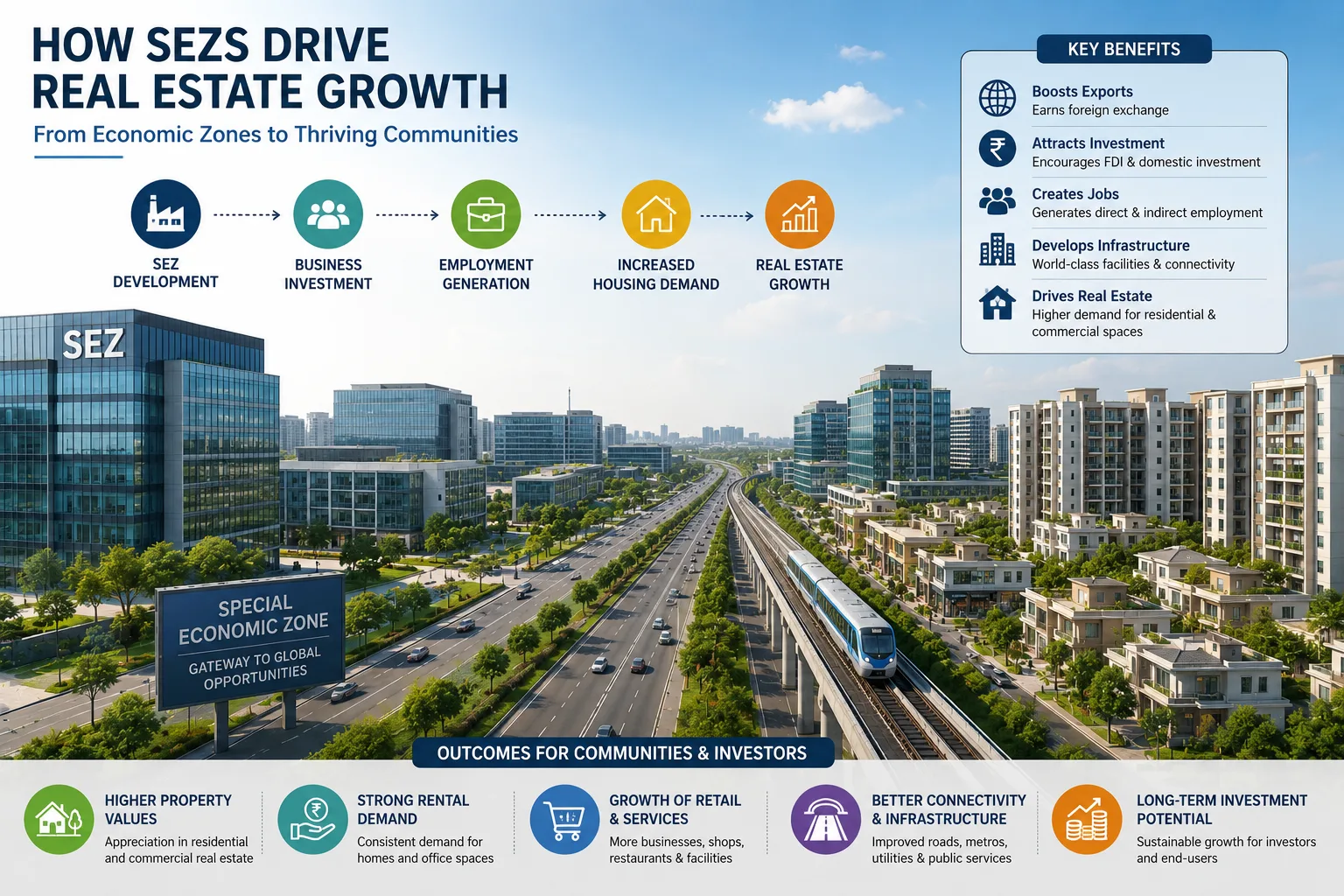
An SEZ generally consists of a designated area developed for specific economic activities.
Depending on the type and scale of the project, an SEZ may include:
- Office buildings
- IT and technology campuses
- Industrial facilities
- Warehouses
- Logistics infrastructure
- Internal roads
- Power and utility systems
- Water and waste-management facilities
- Parking and transport facilities
- Business support services
The development model can involve government agencies, state industrial-development bodies or private developers.
The Ministry of Commerce’s operational-SEZ list includes projects across multiple states and sectors, ranging from IT/ITES and electronics to pharmaceuticals, engineering and multi-product zones.
Objectives of SEZs in India
The SEZ framework was created with several economic objectives.
Key objectives include:
- Promoting exports
- Attracting investment
- Generating employment
- Developing modern infrastructure
- Improving India’s global competitiveness
- Supporting technology-intensive industries
- Encouraging integration with global value chains
- Promoting regional economic development
The larger goal is to create concentrated business ecosystems where companies can access infrastructure, talent, suppliers and trade-related facilities.
Key Features of SEZs
SEZs differ from ordinary commercial or industrial locations because they operate within a specialised policy framework.
1. Special Customs and Trade Provisions
Eligible SEZ units can receive duty-free import or domestic procurement benefits for authorised operations, subject to applicable regulations.
These provisions are designed to reduce certain costs associated with international trade and business operations.
2. Single-Window Clearance
The SEZ framework provides mechanisms for simplified approvals and single-window processing for specified central and state-level requirements.
This can reduce administrative complexity for eligible businesses.
3. GST Benefits
Supplies to SEZ units for authorised operations can qualify as zero-rated supplies under the IGST framework, subject to applicable conditions.
This replaced several older indirect-tax exemptions that existed before GST.
4. Purpose-Built Infrastructure
Many SEZs are developed with dedicated infrastructure designed around commercial, industrial or technology businesses.
5. Export Orientation
SEZs were established primarily to support export-oriented economic activity and help Indian businesses compete internationally.
Are SEZs Tax-Free in India?
This is one of the most misunderstood aspects of SEZs.
Many older articles describe SEZs as completely tax-free zones. That is not an accurate description of the current framework.
The SEZ policy historically provided income-tax incentives to eligible units under Section 10AA, but the relevant sunset provisions mean that businesses cannot simply assume that a new SEZ unit automatically receives a broad income-tax holiday.
Similarly, several historical tax benefits available to SEZ developers have sunset provisions.
Current benefits depend on factors such as:
- Eligibility of the unit
- Date of commencement
- Nature of the activity
- Authorised operations
- Applicable tax provisions
- Customs rules
- GST regulations
- Government notifications
Therefore, businesses and investors should verify the current tax and regulatory position before making investment decisions.
Types of SEZs in India
SEZs can be developed around different sectors and economic activities.
1. Multi-Product SEZs
These large zones can accommodate businesses from multiple eligible industries.
They may combine manufacturing, services, logistics and other economic activities.
2. Sector-Specific SEZs
These zones focus on a particular industry.
Examples include:
- Pharmaceuticals
- Biotechnology
- Electronics
- Engineering
- Textiles
- Chemicals
- Food processing
Sector-specific zones can create specialised business ecosystems and supply chains.
3. IT/ITES SEZs
IT and IT-enabled services have historically represented a major segment of India’s SEZ ecosystem.
Technology-focused SEZs are particularly important in cities such as Bengaluru, Hyderabad, Pune, Chennai and the Delhi-NCR region.
4. Free Trade and Warehousing Zones
FTWZs focus on international trade, warehousing and logistics-related activities.
Their importance can increase as India’s logistics infrastructure and participation in global supply chains expand.
Economic Benefits of SEZs
1. Export Growth
Exports remain one of the central objectives of India’s SEZ policy.
According to the Ministry of Commerce and Industry, exports from SEZs reached approximately ₹14.57 lakh crore ($172.27 billion) in FY 2024–25, compared with ₹13.55 lakh crore in FY 2023–24.
This demonstrates the continuing role of SEZs in India’s export ecosystem.
2. Employment Generation
SEZs create both direct and indirect employment.
Direct employment
People employed by companies operating inside the zone.
Indirect employment
Jobs generated through:
- Transportation
- Security
- Construction
- Facility management
- Food services
- Retail
- Maintenance
- Hospitality
- Professional services
The official SEZ data reported approximately 31.94 lakh employees across SEZs as of March 2024.
This employment concentration is particularly relevant to residential and commercial real estate.
3. Infrastructure Development
A successful SEZ requires supporting infrastructure.
This can encourage improvements in:
- Roads
- Public transport
- Power supply
- Water infrastructure
- Telecommunications
- Logistics
- Commercial facilities
When these improvements extend beyond the SEZ boundary, surrounding locations can also benefit.
How SEZs Impact Real Estate in India
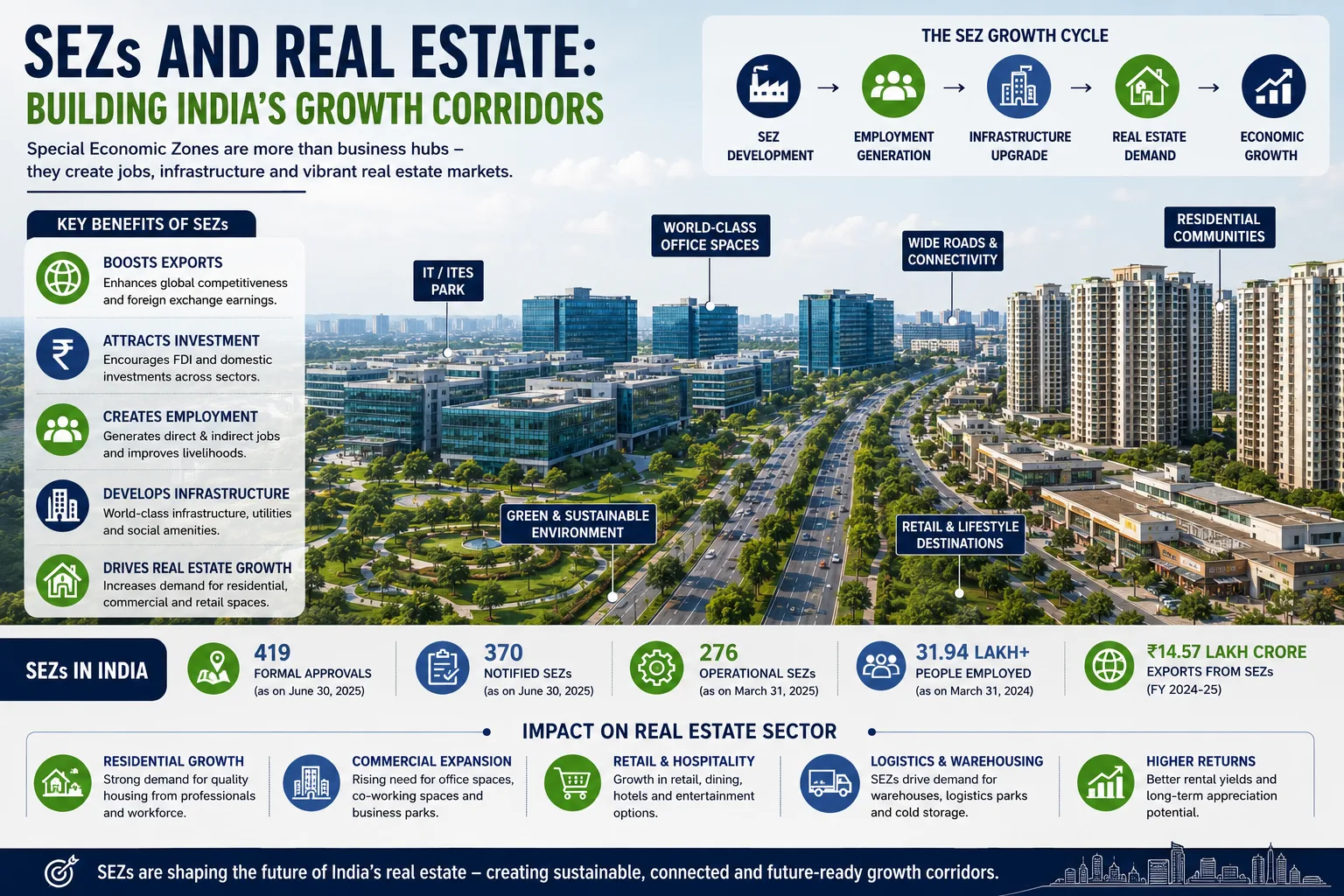
The relationship between SEZs and real estate is one of the most important considerations for property investors.
The economic mechanism is relatively straightforward:
SEZ investment → Company expansion → Employment → Housing demand → Retail demand → Infrastructure → Commercial development → Urban expansion
However, this process is not automatic.
A notified SEZ with limited occupancy may have a much smaller real estate impact than a fully operational SEZ with thousands of employees and strong connectivity.
1. Residential Property Demand
Large employment centres can create demand for nearby housing.
This can benefit:
- Apartments
- Rental housing
- Gated communities
- Co-living projects
- Serviced apartments
- Affordable housing
Employees generally prefer homes that offer reasonable commuting times and access to transport and daily necessities.
2. Commercial Real Estate Growth
SEZ ecosystems can support demand for:
- Office buildings
- Business centres
- Co-working spaces
- Restaurants
- Banks
- Clinics
- Retail stores
- Professional services
India’s broader office market remains strong. Grade-A office leasing across the top seven cities reached 71.5 million sq ft in 2025, up 6% year-on-year, according to Colliers.
In Q1 2026, leasing reached another 18.3 million sq ft, with Bengaluru and Hyderabad together accounting for nearly half of the quarter’s activity.
While these figures represent the wider office market rather than SEZs alone, they highlight the continuing importance of employment-led commercial real estate.
3. Rental Market Growth
An expanding employment hub can create a strong tenant base.
This can support rental demand for:
- 1BHK apartments
- 2BHK apartments
- 3BHK apartments
- Co-living spaces
- Furnished apartments
- Corporate accommodation
The strength of rental demand depends heavily on employment density, salary levels, commuting patterns and the supply of competing housing.
4. Land Value Appreciation
SEZ development can increase the attractiveness of surrounding land, particularly when accompanied by:
- New roads
- Metro or rail connectivity
- Large employers
- Residential projects
- Retail development
- Schools
- Hospitals
- Logistics infrastructure
But investors should be careful.
An SEZ announcement does not guarantee property appreciation.
The more reliable indicators are actual investment, operational companies, employment generation and infrastructure delivery.
SEZ Locations to Watch in India
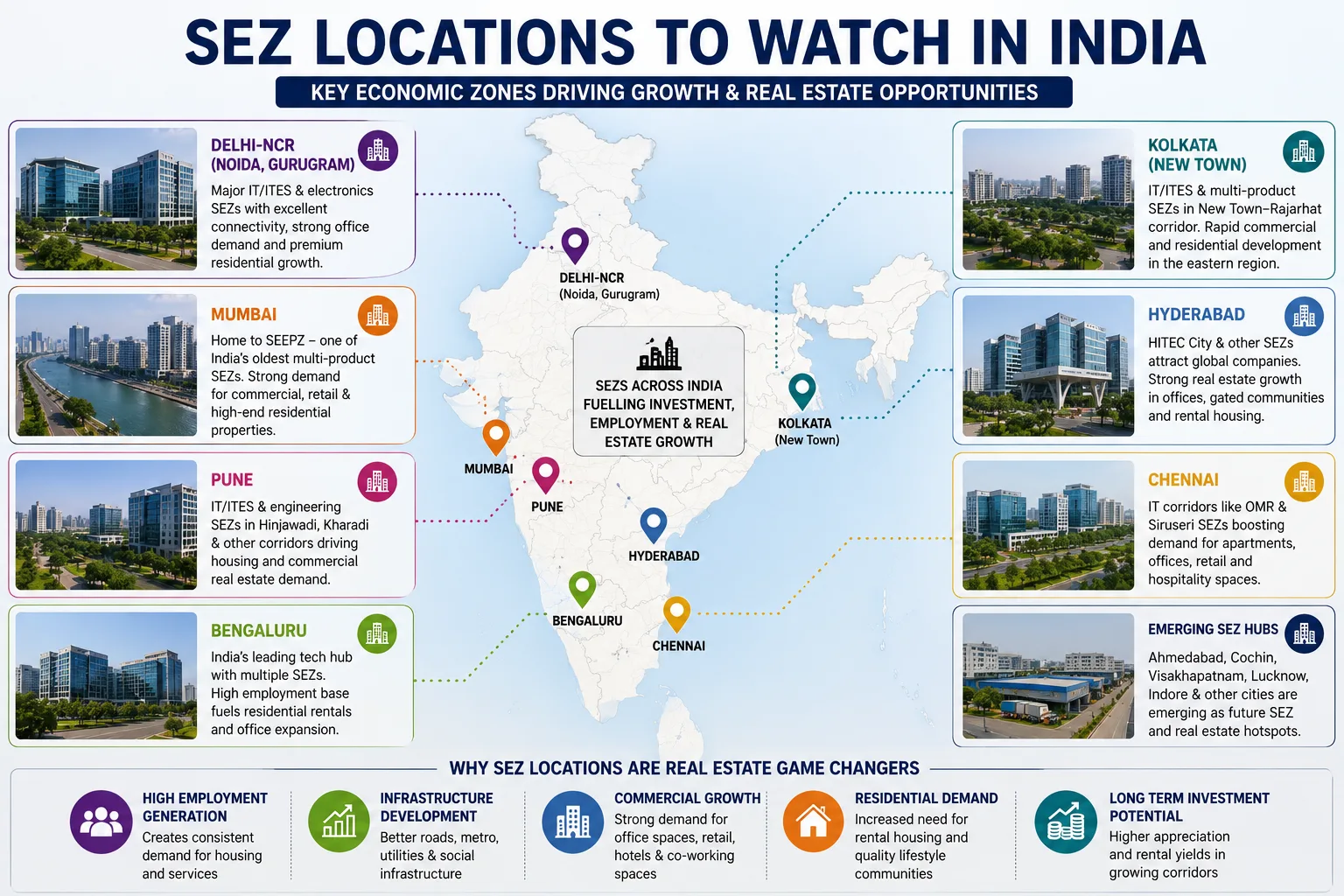
Not every SEZ deserves the same investment attention.
For real estate investors, the most interesting locations are generally those where SEZ activity overlaps with strong employment, infrastructure and broader commercial demand.
1. Bengaluru, Karnataka
Bengaluru remains India’s leading technology and office market.
The official operational-SEZ list includes multiple IT/ITES developments across Bengaluru, including projects associated with major technology and real estate companies.
The city’s broader office market remains exceptionally strong. Bengaluru recorded 22.1 million sq ft of Grade-A leasing in 2025, representing nearly one-third of demand across India’s top seven office markets.
Real estate angle
Investors should watch established employment corridors and peripheral areas where office expansion is accompanied by residential and infrastructure development.
2. Hyderabad, Telangana
Hyderabad has developed into one of India’s major technology, life-sciences and commercial real estate markets.
The city’s office market was one of India’s strongest performers in early 2026, with Hyderabad and Bengaluru together accounting for nearly half of Q1 leasing across the top seven cities.
Colliers also identifies Hyderabad’s peripheral markets as emerging real estate growth areas, supported by infrastructure expansion and business activity.
Real estate angle
West, north, south and eastern peripheral corridors deserve attention where employment growth and infrastructure development converge.
3. Delhi-NCR, Especially Noida and Gurugram
Delhi-NCR is one of India’s most diversified commercial markets.
The operational SEZ list includes multiple IT/ITES SEZs in Noida, including developments in Sectors 144 and 157.
The wider Delhi-NCR office market also remains one of India’s largest, with more than 10 million sq ft of Grade-A leasing recorded during 2025.
Real estate angle
Noida and Gurugram can offer opportunities where SEZ activity intersects with:
- IT employment
- Expressway connectivity
- Metro infrastructure
- Residential development
- Retail and hospitality
4. Pune, Maharashtra
Pune combines technology, engineering, manufacturing and BFSI demand.
The official operational-SEZ list includes IT/ITES projects such as EON Kharadi and Wipro’s SEZ in Hinjawadi, along with sector-specific developments.
Pune also recorded particularly strong office-space growth in 2025, with Colliers reporting significant annual demand momentum.
Real estate angle
Technology and employment corridors around Kharadi, Hinjawadi and other established business districts remain important areas to monitor.
5. Chennai, Tamil Nadu
Chennai combines IT, manufacturing, automotive and engineering activity.
The city is also one of India’s major office markets and recorded strong Grade-A leasing activity during 2025.
Real estate angle
The combination of technology employment, manufacturing and transport infrastructure makes Chennai an important market for long-term commercial and residential development.
6. Kolkata and New Town–Rajarhat, West Bengal
Kolkata is particularly relevant for eastern India’s technology and commercial real estate ecosystem.
The official operational-SEZ list includes multiple SEZs in Kolkata and the Rajarhat/New Town region, including IT/ITES projects and the Manikanchan SEZ.
Real estate angle
The New Town–Rajarhat corridor is particularly worth monitoring because of its concentration of technology, commercial and urban-development activity.
7. Mumbai, Maharashtra
Mumbai remains India’s major financial and corporate centre.
The official SEZ list includes SEEPZ in Mumbai, a long-established multi-product SEZ with electronics and gems-and-jewellery activities.
Real estate angle
Mumbai’s SEZ impact needs to be evaluated alongside its much larger financial, corporate and infrastructure ecosystem.
SEZ vs Normal Business Area
| Factor | SEZ | Conventional Business Area |
| Regulatory framework | Special SEZ framework | General framework |
| Customs treatment | Special provisions may apply | Standard customs rules |
| Export orientation | Strong | Varies |
| Infrastructure | Often purpose-built | Depends on location |
| GST treatment | Special provisions for eligible SEZ supplies | Normal GST framework |
| Business concentration | Often high | Varies |
| Real estate impact | Can create concentrated employment demand | Depends on economic activity |
The key point is that an SEZ does not automatically outperform every conventional business district.
Its real estate impact depends on the strength of the underlying economic ecosystem.
Challenges Facing SEZs in India
1. Policy Changes
Changes to tax and trade policies can influence the attractiveness of SEZs.
Businesses making long-term investments need regulatory predictability.
2. Land and Approval Challenges
Large SEZ projects require substantial land and infrastructure.
Land is a state subject, and the process of procuring land follows the policies and procedures of the respective state governments.
Delays in land acquisition, approvals or infrastructure can affect project timelines.
3. Underutilisation
A major distinction needs to be made between:
Approved SEZ → Notified SEZ → Operational SEZ
An approved project may not necessarily become a fully occupied economic centre.
Investors should therefore examine actual occupancy and business activity instead of relying only on government approval status.
4. Global Competition
India competes with other countries for multinational investment and export-oriented businesses.
Infrastructure quality, talent availability, operating costs, logistics efficiency and regulatory certainty all influence corporate location decisions.
What Does the Future Hold for SEZs in India?
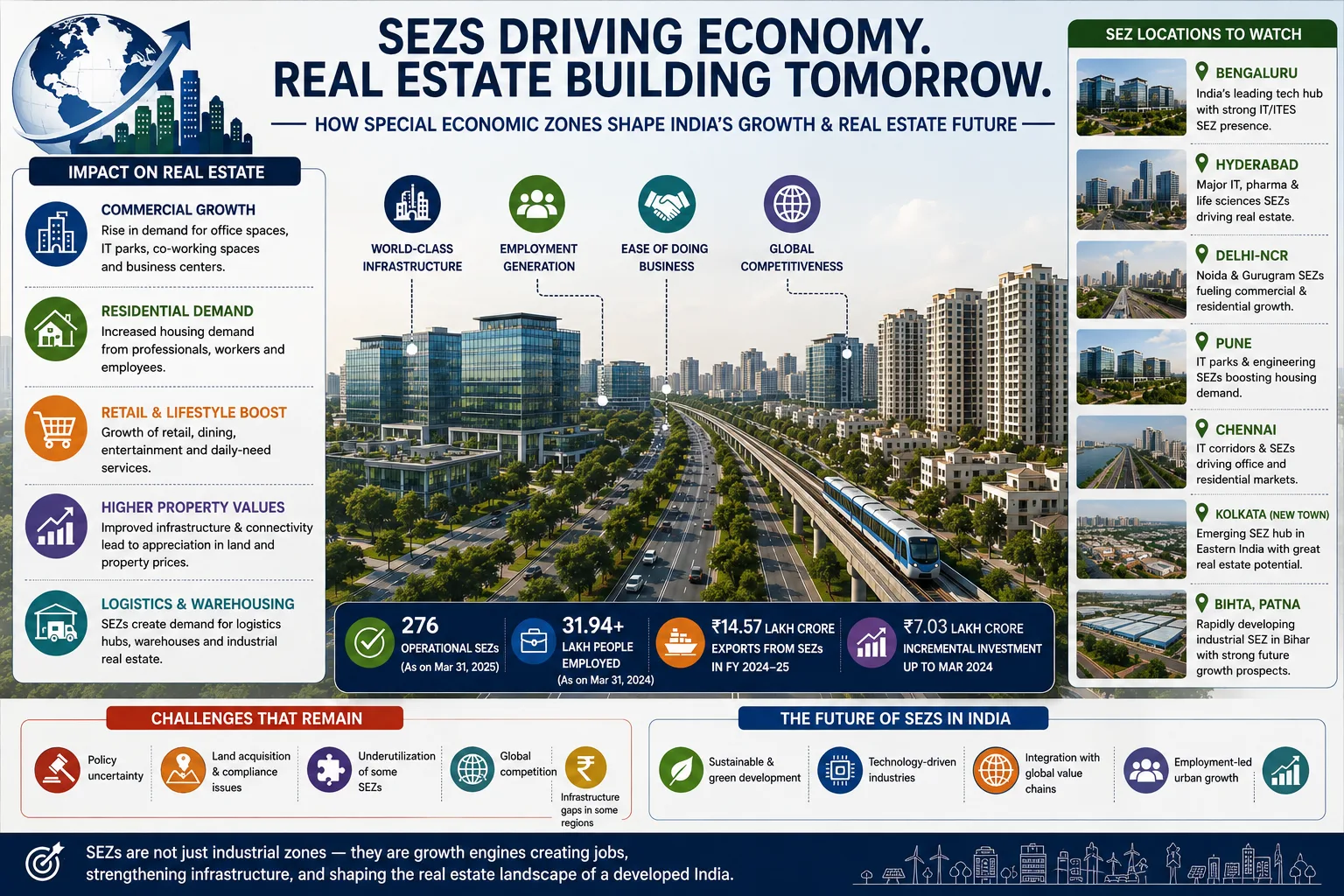
The future of SEZs is likely to depend less on traditional tax holidays and more on the quality of the overall business ecosystem.
Important areas include:
Integration with industrial corridors
SEZs can become part of larger manufacturing, logistics and technology clusters.
Better use of existing SEZ infrastructure
Improving occupancy and productivity in existing zones can be as important as creating new ones.
Growth of technology and advanced manufacturing
Electronics, engineering, biotechnology, data infrastructure and other knowledge-intensive industries could create new demand.
Improved logistics
Road, rail, port, airport and multimodal connectivity can determine the competitiveness of an economic zone.
Employment-led urban development
The most successful zones will increasingly need to function as part of complete urban ecosystems rather than isolated business parks.
Should You Invest in Property Near an SEZ?
An SEZ can be a positive real estate catalyst, but it should not be treated as a guarantee of appreciation.
Before buying property near an SEZ, evaluate:
1. Is the SEZ actually operational?
Check whether companies are functioning there rather than relying on an announcement.
2. How many companies are present?
Occupancy provides a better indication of real economic activity.
3. How many jobs does the zone support?
Employment is a major driver of housing and rental demand.
4. How accessible is the location?
Evaluate highways, metro, railways, airports and public transport.
5. Is housing supply keeping pace?
Strong employment combined with limited quality housing can support rental demand.
6. Are social amenities developing?
Look for:
- Schools
- Hospitals
- Supermarkets
- Restaurants
- Entertainment
- Banks
- Fitness centres
7. What is the future supply?
A market flooded with new residential or commercial projects can reduce rental yields and delay capital appreciation.
The Real Estate Investment Formula for SEZ Locations
A useful way to evaluate an SEZ-driven real estate market is:
SEZ + Employment + Connectivity + Infrastructure + Housing Demand − Excess Supply = Real Estate Potential
The SEZ itself is only one part of the equation.
The strongest opportunities generally emerge when multiple growth drivers reinforce each other.
Frequently Asked Questions About SEZs in India
What is an SEZ?
A Special Economic Zone is a designated area operating under a specialised economic and regulatory framework designed to facilitate investment, trade and exports.
What is the main purpose of SEZs?
The major objectives include promoting exports, attracting investment, generating employment, developing infrastructure and improving India’s global competitiveness.
How many operational SEZs are there in India?
According to the Ministry of Commerce and Industry, India had 276 operational SEZs as of March 31, 2025.
Are SEZs completely tax-free?
No. The commonly repeated idea that every SEZ business is completely tax-free is outdated. Several historical tax incentives have sunset provisions, and current benefits depend on eligibility and applicable laws.
Does an SEZ increase nearby property prices?
An SEZ can contribute to property demand by generating employment and encouraging infrastructure development, but it does not automatically guarantee property-price appreciation.
Is buying property near an SEZ a good investment?
It can be, but investors should evaluate operational activity, employment, connectivity, infrastructure, rental demand and competing property supply before investing.
Which cities have major SEZ activity?
Major SEZ and employment ecosystems can be found in Bengaluru, Hyderabad, Delhi-NCR, Pune, Chennai, Mumbai, Kolkata and other Indian cities.
Which SEZ locations should real estate investors watch?
Bengaluru, Hyderabad, Noida, Gurugram, Pune, Chennai and the Kolkata/New Town-Rajarhat region are among the locations worth monitoring because of their combination of SEZ activity, employment and broader commercial real estate development.
What is the difference between an SEZ and an industrial area?
An SEZ operates under a specialised legal and trade framework with specific customs, GST and procedural provisions. A conventional industrial area generally operates under the standard regulatory framework.
Final Takeaway
Special Economic Zones remain an important part of India’s economic and urban-development landscape.
Their significance goes beyond exports and business incentives. Successful SEZs can create employment centres that influence housing, office space, retail, logistics and infrastructure demand across surrounding areas.
However, the presence of an SEZ should never be the sole reason to purchase property.
For real estate investors, the better strategy is to identify locations where several fundamentals come together:
Operational SEZ + Employment Growth + Strong Connectivity + Infrastructure Investment + Residential Demand + Sustainable Supply
That combination is much more meaningful than an SEZ announcement alone.
As India’s technology, manufacturing, services and logistics sectors continue to expand, well-connected economic zones can remain important catalysts for the next generation of commercial and residential real estate growth.

%20in%20India:%20Meaning,%20Benefits,%20Challenges,%20Real%20Estate%20Impact%20&%20Future)